| POPULATION: |
|
 |
| LITERACY RATE: |
|
|
| SELF DEFENSE FORCES: |
|
|
| LANGUAGES: |
|
|
| ETHNIC GROUPS: |
|
|
| BORDERING COUNTRIES: |
|
| POPULATION: |
|
|
| LITERACY RATE: |
|
|
| SELF DEFENSE FORCES: |
|
|
| LANGUAGES: |
|
|
| ETHNIC GROUPS: |
|
|
| BORDERING COUNTRIES: |
|
 independence from Belgium in 1960. Mostly the cause was government
greed. In 1994 refugees in the millions began fleeing the into the
DRC to escape the tribal wars being fought in Rwanda and Burundi between
the Hutus and the Tutsis. Out of fear of overcrowding the military
was sent to the borders to stem the flow of refugees. This turned
into a long bloody ordeal with the military slaughtering refugees by the
thousands. This led to the forming of rebel groups, and the bloody
fighting between the rebels and the government led nearly a million refugees
to return to Rwanda over the next several years. This was not the
least of Zaire's problems as there were brief conflicts with many of their
neighbors. War would probably have broken out if not for two factors.
Firstly most of their neighbors had their own problems to deal with, and
secondly the DRC frankly could not afford to go to war with another country.
Years of conflict, corrupt government, political instability and tribal
wars had left the DRC floundering and poverty stricken. The military
had a long history of mutinies causing massive death tolls and property
loss, the major underlying cause was the governments inability to pay their
soldiers enough to support themselves or their families. In
2011 after the assassination of president M'kele Tobumbu Maskabe and the
election of Tananga Umfufu Walanga, these military mutinies continued as
the new president turned out to be even more corrupt and despotic than
his predecessor. Finally in 2018 things came boiling to a head.
In a violent coup led by General Charles K'Sala Okumbe, who had up until
then been the presidents most trusted man, the military split nearly in
half. It began with a failed assassination on the president, this
led to a brief but bloody massacre in the capital city of Kinshasha where
200 were killed, mostly civilians who were in the crossfire. General
Okumbe fled the city and headed east, taking his loyal followers with him.
Soon it was evident that the country was headed for complete civil war.
President Walanga gathers and recruits all those loyal to him, increasing
his soldiers pay from his own coffers while General Okumbe sets up his
base of power as a military stronghold near Bukavu, and begins actively
assimilating the all rebel forces under his command promising them to completely
overthrow the government and free the people. The refugees who had
escaped into Zaire from Rwanda come rallying to his side. They
fail to see from his actions, such as the genocidal slaughter of entire
villages loyal to Walanga that he is every bit as oppressive.
independence from Belgium in 1960. Mostly the cause was government
greed. In 1994 refugees in the millions began fleeing the into the
DRC to escape the tribal wars being fought in Rwanda and Burundi between
the Hutus and the Tutsis. Out of fear of overcrowding the military
was sent to the borders to stem the flow of refugees. This turned
into a long bloody ordeal with the military slaughtering refugees by the
thousands. This led to the forming of rebel groups, and the bloody
fighting between the rebels and the government led nearly a million refugees
to return to Rwanda over the next several years. This was not the
least of Zaire's problems as there were brief conflicts with many of their
neighbors. War would probably have broken out if not for two factors.
Firstly most of their neighbors had their own problems to deal with, and
secondly the DRC frankly could not afford to go to war with another country.
Years of conflict, corrupt government, political instability and tribal
wars had left the DRC floundering and poverty stricken. The military
had a long history of mutinies causing massive death tolls and property
loss, the major underlying cause was the governments inability to pay their
soldiers enough to support themselves or their families. In
2011 after the assassination of president M'kele Tobumbu Maskabe and the
election of Tananga Umfufu Walanga, these military mutinies continued as
the new president turned out to be even more corrupt and despotic than
his predecessor. Finally in 2018 things came boiling to a head.
In a violent coup led by General Charles K'Sala Okumbe, who had up until
then been the presidents most trusted man, the military split nearly in
half. It began with a failed assassination on the president, this
led to a brief but bloody massacre in the capital city of Kinshasha where
200 were killed, mostly civilians who were in the crossfire. General
Okumbe fled the city and headed east, taking his loyal followers with him.
Soon it was evident that the country was headed for complete civil war.
President Walanga gathers and recruits all those loyal to him, increasing
his soldiers pay from his own coffers while General Okumbe sets up his
base of power as a military stronghold near Bukavu, and begins actively
assimilating the all rebel forces under his command promising them to completely
overthrow the government and free the people. The refugees who had
escaped into Zaire from Rwanda come rallying to his side. They
fail to see from his actions, such as the genocidal slaughter of entire
villages loyal to Walanga that he is every bit as oppressive.
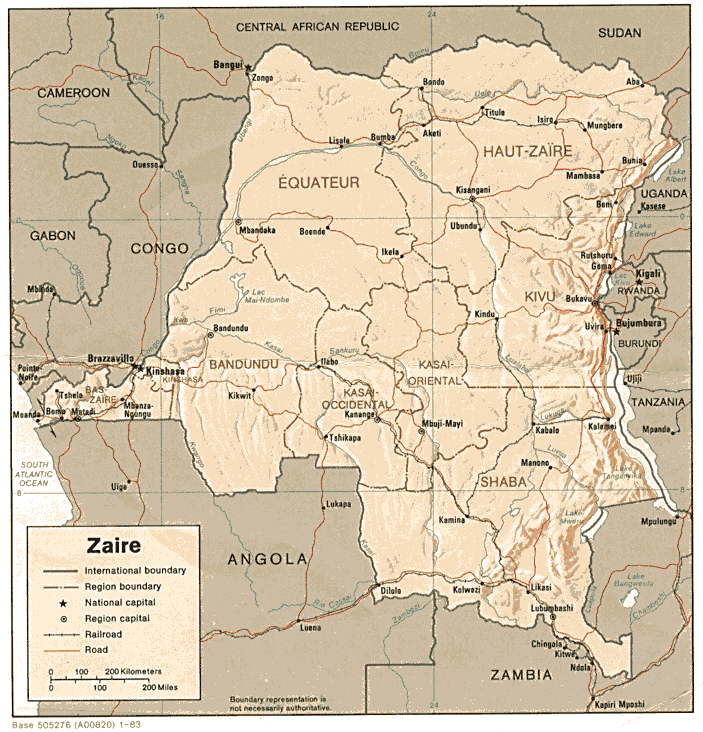
For six months massive fighting breaks out, depleting the reserves and supplies of both sides of the conflict. In November of 2018 General Okumbe petitions the EEC for aid, giving them nearly full control of his military and promising to fall under the same conditions as the rest of the European controlled "protected" countries in Africa. Upon hearing of this threat and fearing almost certain defeat at the hands of the Europeans President Walanga immediately turns to the U.S. for aid. Offering much of the same deal to the Americans as Okumbe did for the EEC, with added bonus that officially he still controls the country he all but begs the U.S. to send in the U.S. Military. Initially cautious, not wanting to start a world war from which no one on earth could win the U.S. reluctantly begins sending in troops. For the first year neither the U.S. or the EEC engage each other, mostly it remains posturing by both sides as military leaders try to come to a peaceful agreement. Both the U.S. and the EEC arrange for a complete media blackout in the area in effort to prevent full scale war as tensions escalate in the DRC. Then in an unexpected move in early 2019, Okumbe sends his own elite forces, bolstered by EDF troops on a raid against a U.S. military base near Ikela. The move is not officially sanctioned by the EDF but nevertheless the incident escalates almost overnight into full scale conflict in Zaire. U.S. troops actively pursue and openly engage the attackers, the move is reacted to instantly as EDF forces bomb U.S. bases up and down the center of the country. From here out the country falls into war.
The war in the DRC closely resembles the conflict in Vietnam of 50 years earlier in terms of how it is fought. Because of the immense size of the country, and the relative equal terms of the U.S. and EEC supported armies gaining and keeping ground is a constant tag. After a year of fighting neither side seems to be gaining ground, and death tolls are escalating, as well as the amount of respective U.S. and EDF troops sent to the area. Both the U.S. and the EEC work feverishly to keep the conflict contained to the DRC, trying at all costs to avoid sparking a 3rd world war. Yet neither side seems willing to give up the prize of Zaire, as whichever side gains it will definitely have the advantage in Africa.
Most of the fighting takes place in the center of the country, among the dense jungles and highlands. In addition there are also tribal wars breaking out in the country as tribes caught in the crossfire are driven from their villages. A third party has also risen in Zaire, one that opposes both sides and makes pacts with neither the U.S. or the EEC. This faction is known as the Zaire Liberation Front. Poorly armed and equipped, mostly using old military surplus from all over the world as well as new technology and weapons from China. They are made up mostly of refugees and awol soldiers and have begun actively recruiting mercenaries from all over the world. Using guerrilla tactics they have centered themselves in the north and make hit and run raids on both sides.
For civilian natives in the DRC life is hell, most for fear of death make no allegiances whatsoever. Medical care is almost nonexistent, as are modern technology. In fact, due to the fighting that engulfs the country many civilians have fled the es and reverted to a primitive lifestyle. Many in the country, including the EDF backed armies of Okumbe, the name of the country is Zaire, this trend has been extended to U.S. troops, who alternate between Zaire and DRC for matters of convenience. To Walanga and the official government the country remains the Democratic Republic of Congo.
Despite
the turmoil and conflict in Zaire, the land and people itself are considered
by many to be the continents best representation of the true Africa.
More than 250 seperate tribes call this land their home, each with their
own history culture and art. Their are a few modern es, but outside
the es the natives have reverted back to tribal lifestyles, living
in small villages, often made of grass huts, or in some cases simple shacks
made from sheet metal. The landscape of the DRC is almost magical,
and varies incredibly. Most of the country is covered by lush jungle,
a tropical rainforest that still hides its secrets, or woodland savannas,
where tall grass and other decidous plants soak up the harsh sun.
Along the eastern borders of Rwanda, Burundi and Tanzania you will find
more of a forest tundra, where the heat keeps everything dry and lazy.
There is even a small semi-desert extending from angola. Mountains
and hills splatter the country, and lakes and rivers are plentiful.
The Congo river is huge, and traverses much of the country. Truly
the DRC is home to al climes, and because of this it is also home to an
incredibly diverse array of wildlife. Apes and mokeys, hippo's and
Rhino's, all the species of big cats found in africa, birds of every shape,
size and color, and of course reptiles. If Zaire were ever to work
through its problems, it would truly be a tropical paradise, and draw immense
trade from tourism. However, due to the conflict, all unnecesary
travel to DRC is to be strictly avoided.
(Written by Deric "D" Bernier)